Midknight Autonomous AI Retention agent

Available

Customer service

How an autonomous AI customer service knight helps a D2C brand turn its inbox into a structured source of product and operations intelligence.

A support inbox is not a cost center. It is a signal.

Footwear brands attract a specific kind of support volume. Sizing is never obvious. A customer ordering their first pair wants to know whether to size up, whether the leather stretches, whether the last runs narrow. A customer who received the wrong size wants to know how to exchange within 48 hours before a trip. A customer whose sole is coming apart six weeks after purchase wants a resolution, fast, and they want to feel heard.

Picture a growing Shopify footwear brand receiving 250 to 300 support tickets every week. Two people split customer service between other operational responsibilities. First response time climbs above 24 hours, longer over weekends. Tickets accumulate. The same sizing question gets answered five different ways depending on who picks it up and when. A customer who just spent €180 on a pair of shoes and cannot get a coherent reply within the day will not order again. At this volume, inconsistency is not a minor issue. It is a churn driver.

Your knight does not just read the message. It reads the customer.

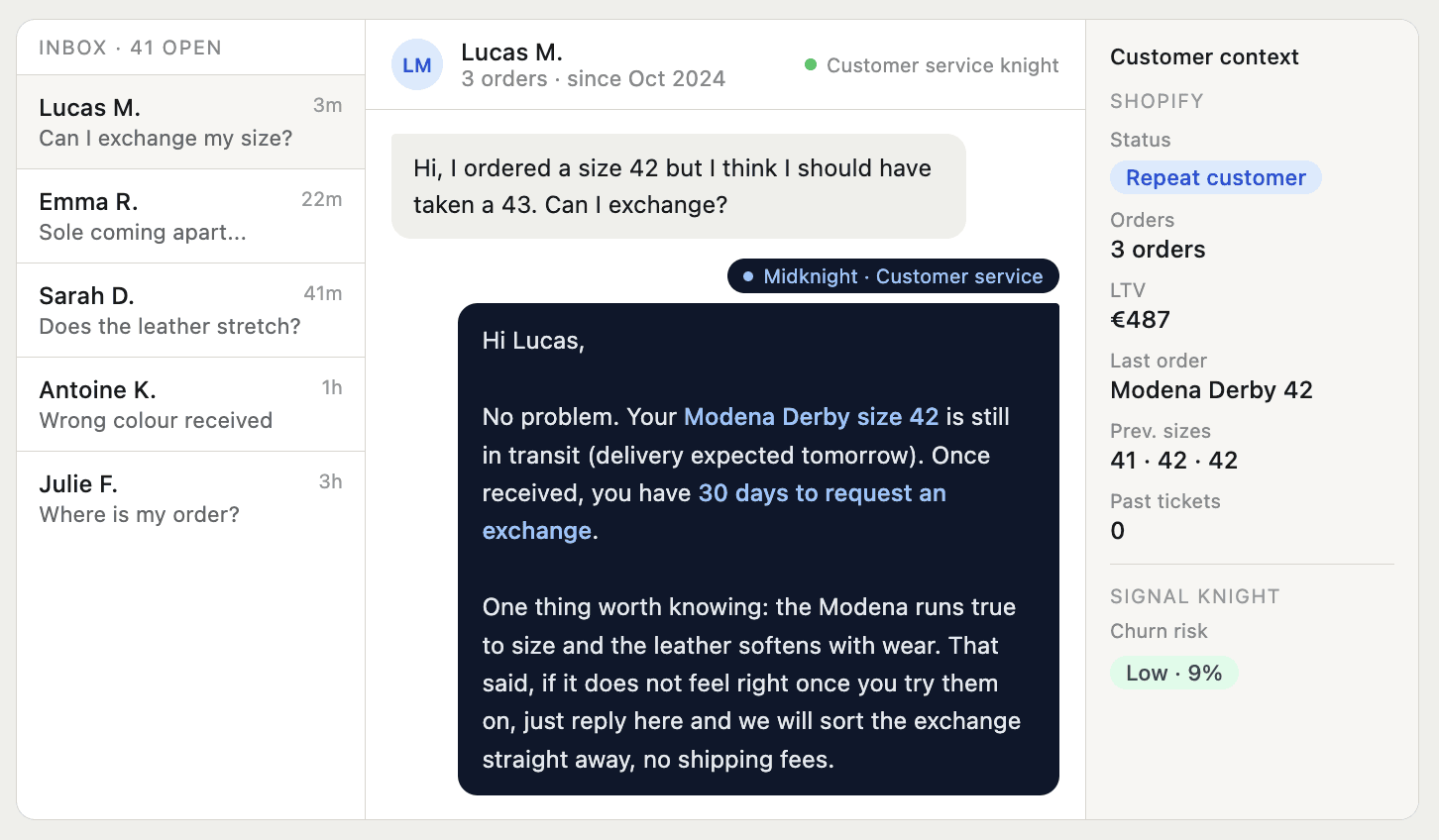
Midknight's customer service knight connects Intercom (or Gmail) and Shopify. When a ticket arrives, it does not pattern-match against a static FAQ. It pulls the full customer record: order history, product purchased, size ordered, delivery status, return history, and previous support interactions.

A customer asking "Can I exchange my size?" receives a response that already accounts for the fact that they ordered a size 42 three days ago, that it has not yet been delivered, and that their previous order last season was a size 41 in a different silhouette. The response is not a template. It is a contextualised answer that anticipates the follow-up question before it is asked.

When the Signal knight is also active, the customer service knight inherits the churn risk score in real time. A high-value customer flagged as high-risk does not get handled the same way as a first-time buyer with a standard query: the response escalates automatically, a goodwill gesture can be triggered, and the ticket is prioritised for human review with a full briefing. A frustrated loyal customer becomes a retention opportunity, not a lost order.

For queries that require human judgment, including complex complaints, suspected product defects, and wholesale or press inquiries, the knight escalates with a complete briefing: who the customer is, what they ordered, their full history, and what they have already been told. The team member picks up a fully understood case, not a cold ticket.
Midknight Autonomous AI Customer service agent
What your inbox tells you that your dashboard never will.

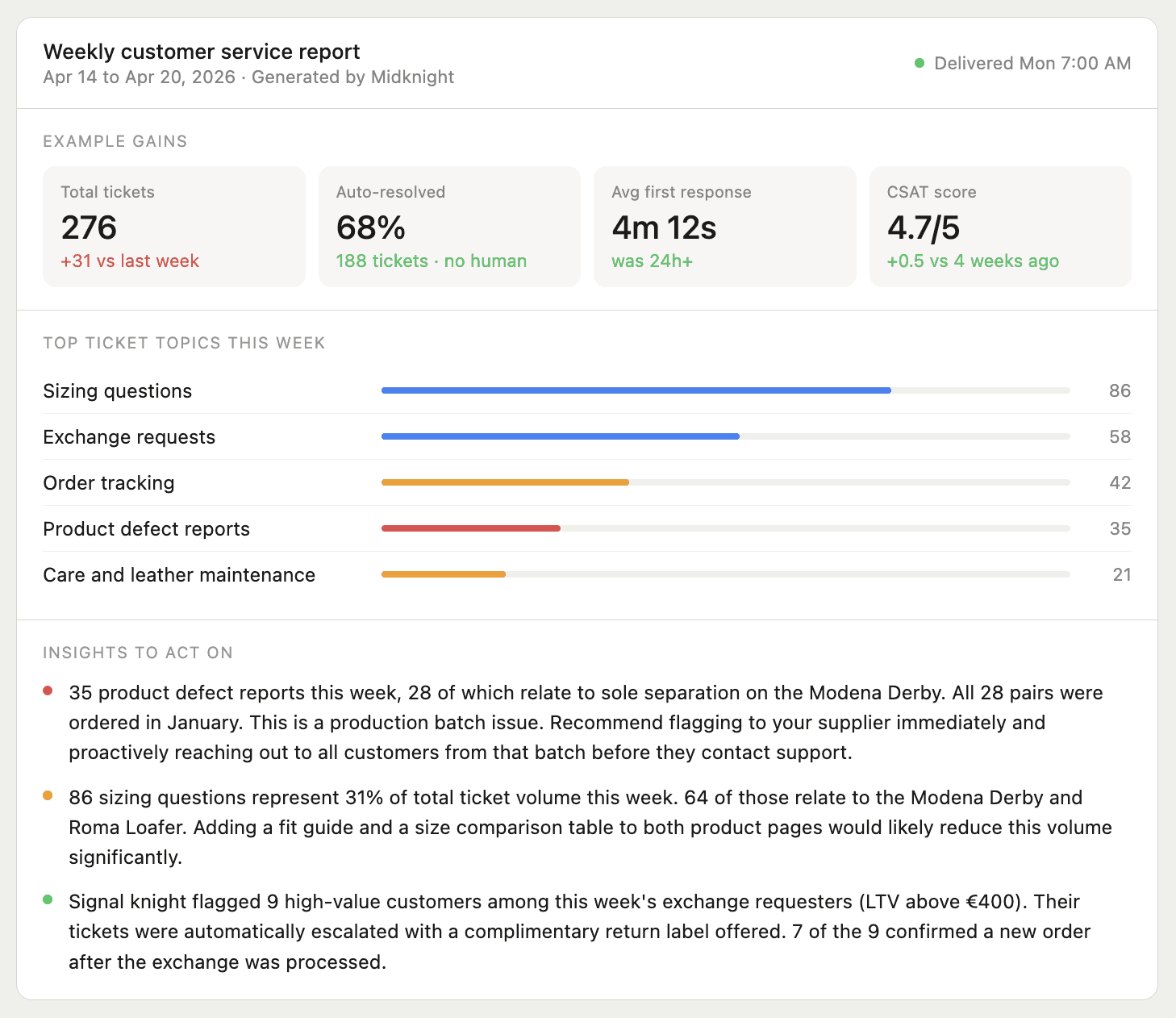
Every Monday morning, the customer service knight delivers a structured weekly report: recurring topics ranked by volume, emerging complaint patterns, questions that signal sizing confusion, and product issues generating disproportionate ticket load. For a footwear brand at this volume, knowing that 35 tickets this week relate to sole separation on the same silhouette is not a support problem.

It is a production alert that needs to reach your supplier before the next batch ships.
Midknight Autonomous AI Customer service agent weekly report

Want to know how our knights can make your brand win?

More insights to explore

Discover additional case studies, tips, and strategies to help your business grow and innovate faster.

Your questions, answered

Your questions, answered

What makes Midknight different from using the built-in AI of each tool separately?

Every tool in your stack already has its own AI, but each one operates in isolation. Your Klaviyo AI doesn't know your ROAS collapsed. Your Meta AI doesn't know your top segment just churned. They're individually smart and collectively blind. Our knights share context and act on the full picture of your business in real time. That's the difference between four isolated copilots and one unified operator.

Does Midknight replace my existing tools?

No. Your knights run on top of your current stack. You keep Shopify, Gorgias, Meta Ads, and the rest. Midknight is the operational layer that connects and activates them.

How long does it take to get started?

Most brands are fully connected and have their first knight running within 48 hours. No engineering work required on your end.

Do I need a developer to connect my tools?

No. Midknight connects directly to your tools (Shopify, Klaviyo, Meta Ads, Intercom and more) through native integrations. No code, no API setup, no technical work required. You can be operational in minutes.

What tools do the knights connect to?

Midknight integrates with Shopify, Meta Ads, Intercom, Gorgias, Klaviyo, Gmail, Google Ads, Google search console, Notion, Slack, and Semrush. These are the core tools D2C brands at €200K–€5M already run on. Your knights activate directly within your existing stack.

Can I start with just one knight?

Yes. You can choose to start with only one knight. You can add knights as you scale.

What happens if a knight makes a wrong recommendation?

You reject it, or improve it. Because every action requires your approval (depending on the level of autonomy you have setup) before execution, a wrong recommendation costs you nothing. You simply decline it. The approval layer exists precisely because no AI is infallible, and Midknight was designed with that assumption baked in.

Who approves the actions before they are executed?

You do, always. Every recommendation a knight makes is submitted to you before anything happens in your stack. Midknight never sends an email, adjusts a campaign, or triggers a workflow without your explicit approval. The knights surface the decision. You make it.

How do the knights work together?

Each knight reads from a shared intelligence layer. When the Customer service knight identifies a recurring topic in tickets, the SEO knight adjusts the FAQ content or write a blog article accordingly. No knight operates in isolation. Their shared context is what makes the system meaningfully smarter than any individual tool AI.

What makes Midknight different from using the built-in AI of each tool separately?

Every tool in your stack already has its own AI, but each one operates in isolation. Your Klaviyo AI doesn't know your ROAS collapsed. Your Meta AI doesn't know your top segment just churned. They're individually smart and collectively blind. Our knights share context and act on the full picture of your business in real time. That's the difference between four isolated copilots and one unified operator.

Does Midknight replace my existing tools?

No. Your knights run on top of your current stack. You keep Shopify, Gorgias, Meta Ads, and the rest. Midknight is the operational layer that connects and activates them.

How long does it take to get started?

Most brands are fully connected and have their first knight running within 48 hours. No engineering work required on your end.

Do I need a developer to connect my tools?

No. Midknight connects directly to your tools (Shopify, Klaviyo, Meta Ads, Intercom and more) through native integrations. No code, no API setup, no technical work required. You can be operational in minutes.

What tools do the knights connect to?

Midknight integrates with Shopify, Meta Ads, Intercom, Gorgias, Klaviyo, Gmail, Google Ads, Google search console, Notion, Slack, and Semrush. These are the core tools D2C brands at €200K–€5M already run on. Your knights activate directly within your existing stack.

Can I start with just one knight?

Yes. You can choose to start with only one knight. You can add knights as you scale.

What happens if a knight makes a wrong recommendation?

You reject it, or improve it. Because every action requires your approval (depending on the level of autonomy you have setup) before execution, a wrong recommendation costs you nothing. You simply decline it. The approval layer exists precisely because no AI is infallible, and Midknight was designed with that assumption baked in.

Who approves the actions before they are executed?

You do, always. Every recommendation a knight makes is submitted to you before anything happens in your stack. Midknight never sends an email, adjusts a campaign, or triggers a workflow without your explicit approval. The knights surface the decision. You make it.

How do the knights work together?

Each knight reads from a shared intelligence layer. When the Customer service knight identifies a recurring topic in tickets, the SEO knight adjusts the FAQ content or write a blog article accordingly. No knight operates in isolation. Their shared context is what makes the system meaningfully smarter than any individual tool AI.